

If you came here from the NSPRA + CoSN webinar, Student Photos in the Age of AI: Rethinking Digital Storytelling, Privacy, & Risk, welcome.
During that conversation, one thing became very clear to me: school communicators are about to be asked to help lead conversations they were never trained to lead. Not because communication has changed, but because the digital environment around it has.
Globally, governments are introducing stronger protections for children’s digital privacy and online experiences. Parents are asking different questions than they did even a few years ago. And younger generations are growing up with a much greater awareness of digital footprints, online identity, and the permanence of what gets shared about them.
Across the country, school communications professionals are beginning to hear new terms in cabinet meetings, conference sessions, and board discussions. Facial recognition. AI scraping. OCR. Metadata. Digital footprints. Online privacy. The problem isn’t that these technologies exist. The problem is that many of these conversations begin before anyone in the room has a shared understanding of what those terms actually mean in the context of school communications.
That creates a huge emerging challenge for our profession.
While we don’t need to become AI experts, we do need to be prepared to participate meaningfully in these conversations. If not, someone else will shape the decisions — decisions that are fundamentally about the work we do each day — for us.
I’m not here to argue that districts need to stop posting student photos carte blanche. I’m also not here to argue that AI changes everything about what we do. I’m definitely not here to give you one singular right answer that applies to every district, every story or every situation. There isn’t one.
What I am here to do is to help my fellow school communicators develop enough practical understanding of today’s digital environment to confidently participate in these conversations so that you’re not scrambling to react to them.
Because, I promise you, these conversations are coming. Maybe not tomorrow, maybe not this year, but they will come. In many districts, they’re already here.
When your superintendent, IT director, school attorney, or board member starts asking questions about student photos, AI, or digital privacy, “but…engagement!” isn’t the most productive response that a communications professional can contribute. Neither is panic. Neither is pretending nothing has changed. We need something better than these extremes.
A Quick Reality Check
Before we go further, I want to pause on something important. When I first started talking about face-free storytelling, I expected the biggest pushback to be about engagement, tradition, or practicality. And as I expected, yes — that came up.
Some communicators quietly shared a deeper concern, and one that I think may be lingering in many others’ minds:
“If we move away from identifiable student photos, what happens to my role? What happens to school communications jobs if this becomes the norm?”
That’s a legitimate fear that deserves a legitimate answer.
So let me say this clearly: face-free storytelling is not about eliminating school communicators or devaluing the creativity, visual instincts, and storytelling expertise that so many of you bring to this profession. It’s about expanding your toolkit so those strengths remain relevant, valuable, and increasingly strategic as the digital environment continues to evolve.
I’d actually argue the opposite of what some people fear is more likely true.
As the digital environment becomes more complex (not less) school districts will need communicators who can:
- Navigate privacy expectations thoughtfully
- Understand how content travels and is interpreted online
- Make strategic decisions about risk and storytelling
- Help leadership teams translate technical concerns into communication choices
- Build trust in environments where audiences are more sensitive to data and imagery than ever before
Whenever a long-standing practice is questioned, it’s natural to wonder what that means for the profession built around it. If you’ve spent years helping your district tell its story through powerful photography, hearing conversations about AI, privacy, and limiting public student photos can feel like the ground is shifting beneath your feet.
But uncertainty about how we tell stories isn’t the same as uncertainty about whether we need storytellers.
Schools will always need skilled communicators. They will always need people who can build trust, celebrate learning, explain complex issues, and help communities understand what happens inside their schools. The need for those skills isn’t changing, the environment in which we apply them is. The communicators who continue to grow, adapt, and expand their toolkit won’t become less valuable. They’ll become even more essential.
“But… engagement!”
One of the most common responses I hear whenever I raise questions about student photos, AI, or alternative storytelling approaches is, “But…engagement!”
It’s a fair point.
Identifiable student faces have long been one of the most effective ways to capture attention online. Humans are naturally drawn to faces, and there’s no reason to pretend otherwise.
But I think we’re asking the wrong question.
Much of the conversation quickly turns into whether a close-up of a smiling student will generate more likes than a photo of a robotics competition, an art project, or a science experiment. That’s an interesting question, but it’s probably not the most important one.
A better question is whether likes are the outcome we’re actually trying to achieve. If our communication goals are to build trust, increase understanding, strengthen community relationships, or encourage participation, then engagement is only one indicator of success, not the destination itself.
A reel with 15,000 views can feel like a tremendous success. But how many of those viewers are actually the families, residents, prospective parents, staff members, or community stakeholders your district is trying to reach? High view counts often include people well outside your community: people who happened to encounter the post because a platform’s algorithm decided they’d find it interesting. There’s nothing wrong with broad reach, but reach alone doesn’t tell you whether you’ve accomplished your communication goal.
It’s also worth asking a second question: What did it cost to achieve those 15,000 views?
If your communications team spent time scripting, filming, editing, adding captions, selecting music, creating graphics, making sure the reel was fully WCAG compliant (as it should be), and revising it three more times before hitting publish, only to have most of those views come from people outside your community, was that the best use of your team’s limited time?
The point isn’t that reels are ineffective or that engagement doesn’t matter. The point is that school communicators need to evaluate success differently than influencers or consumer brands. Our goal isn’t simply to capture attention. It’s to reach the right audience with the right message at the right time, and to help our districts achieve meaningful communication outcomes.
If families still don’t understand the budget proposal, attendance at the community forum is low, prospective families can’t find the information they need, or trust in the district hasn’t improved, what exactly did those 15,000 views accomplish?
Engagement can be an important metric, but it’s not the only metric to be concerned about.
The real work of school communication has always been bigger than generating clicks. It’s about helping families understand what’s happening in their schools, building trust over time, increasing participation, celebrating learning, supporting district priorities, and strengthening relationships with the community.
That’s why I think the conversation around student photos is actually much bigger than student photos. If removing one tactic causes your entire communication strategy to fall apart, then the strategy was probably too dependent on that tactic in the first place.
The districts that will navigate these conversations most successfully won’t be the ones that defend a particular type of photo. They’ll be the ones that can clearly articulate what they’re trying to accomplish and then choose the storytelling approach that best supports that goal. Sometimes that approach will absolutely include student faces, and sometimes it won’t. Don’t optimize for one creative technique. Optimize for outcomes.
The Questions Get Bigger
The more I’ve researched this topic, both before and after the webinar, the more I’ve realized that face-free storytelling is only one piece of a much larger conversation. Once you begin looking at student photos through the lens of today’s digital environment, the questions multiply quickly.
- What information might be traveling inside the photo file itself?
- What can technology read from text in the background of an image?
- What happens when dozens—or even hundreds—of seemingly ordinary posts are connected over time?
- Does it matter whether the same story is published on a public website, social media, or a school-home communications platform?
- What assumptions are we making about the technology we use every day that we’ve never actually verified?
None of those are technology questions alone; they’re communications questions. And they’re already beginning to show up in conference sessions, cabinet meetings, IT discussions, and school board conversations.
Over the coming months, I’ll continue publishing practical articles that explore these questions. Not from the perspective of a technologist or attorney, but from the perspective of a school communicator trying to make thoughtful, balanced decisions in a rapidly changing digital environment. I’m also developing a practical field guide that brings this research together into a framework specifically for school communications professionals.
Because the question isn’t whether your district will eventually ask these questions. The question is whether you’ll be ready to help answer them.
If school communicators can’t confidently explain the opportunities, the tradeoffs, and the realities of today’s digital environment, someone else will shape those decisions for us.
I believe our profession belongs at the center of those conversations. Not because we’re technology experts, but because we’re the professionals responsible for helping our districts communicate thoughtfully, transparently, and strategically and that starts with understanding enough to ask better questions.
If these are conversations you want to be prepared to lead, I'd love to have you join the Brief and Nice community. I'll share new articles, practical resources, and updates as this work continues to evolve. Use the "Let's Stay Connected" form in the footer of this page.
And now, without further ado…the article I published prior to the webinar:
The school communicator’s guide to face-free storytelling
How to create engaging school content without relying on student faces
(hint: it’s not putting an emoji over their faces)
Face-free storytelling isn’t the goal. It’s one example of what becomes possible when we stop thinking about identifiable student faces as the only way to tell compelling school stories.
School communicators are navigating a very different digital landscape than they were even five years ago.
Artificial intelligence, facial recognition, reverse-image search, evolving family expectations and the permanence of online content are prompting some districts to reconsider when and where they publish identifiable student images. I expect many more districts will begin having that conversation in the coming years.
At the same time, communications offices have never been expected to produce more content.
Between websites, social media, newsletters, school-home communications platforms, videos and event coverage, communicators are under constant pressure to document and share what’s happening across their districts.
Administrators want to showcase the work happening in their schools. Board members want their communities to see positive stories. Families want to see their children’s experiences represented. And communications professionals are repeatedly told that publishing more content, more frequently, will increase engagement and strengthen trust.
The result is that districts are publishing more identifiable student content across more platforms (and allowing more people to capture and distribute it) than ever before. That creates a growing tension: At the same time districts are being asked to publish more student content, the risks associated with doing so are becoming more complicated.
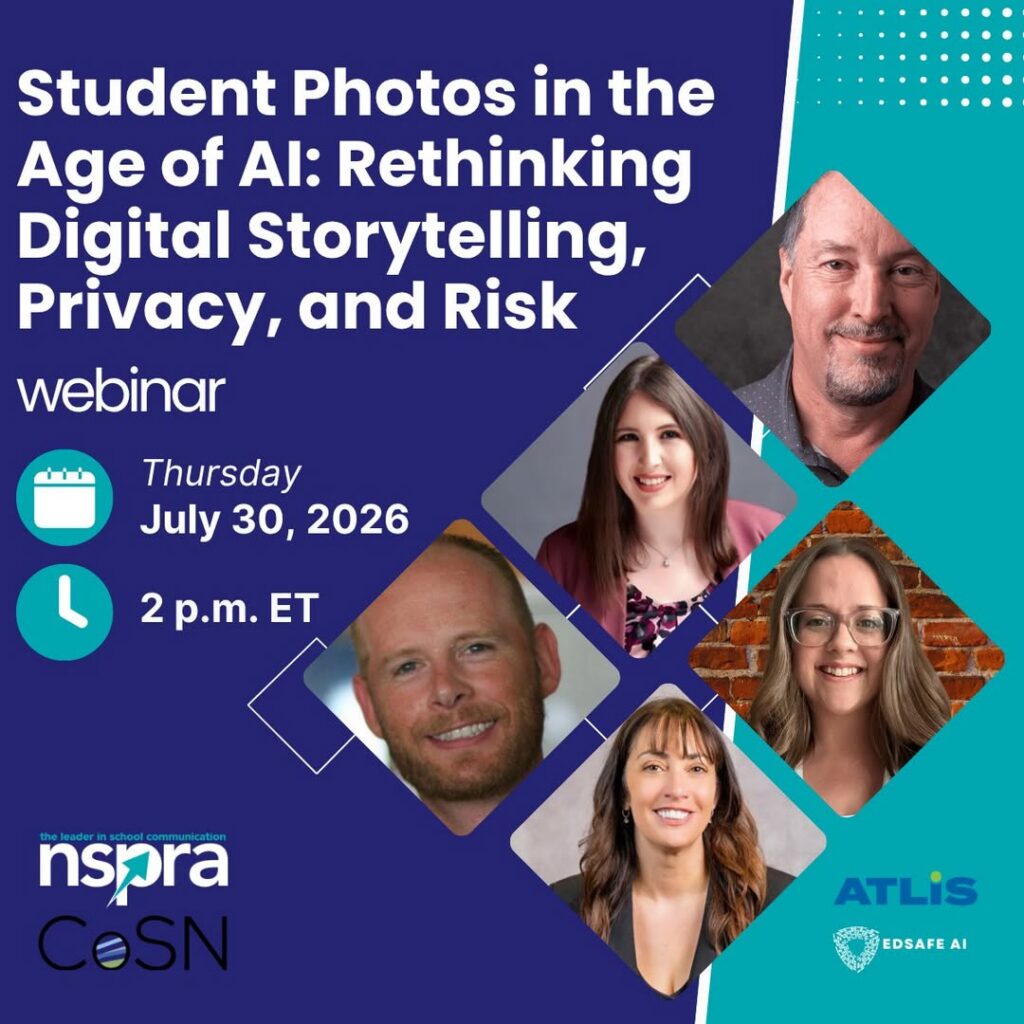
Which is why I was thrilled to be invited to a panel hosted by the National School Public Relations Associations (NSPRA) and the Consortium for School Networking (CoSN).
This free webinar will be held Thursday, July 30 at 2 p.m. EST, and is open to all – no membership in either organization required!
Does this mean districts will have to stop using student photos?
No, not necessarily.
This is an emerging issue, and the conversation is only beginning. But I believe many public school districts will eventually limit the use of identifiable student images in certain online spaces, particularly on social media. That won’t happen everywhere tomorrow. But districts don’t need to wait for a new policy or crisis to begin thinking differently.
My advice is to start experimenting now. Create some content that doesn’t depend on identifiable student images, and watch how your community responds. Treat it as an opportunity to expand your storytelling skills; not as a restriction that makes storytelling impossible.
I hear a lot of alarm in the school PR community whenever this possibility comes up. Somewhere along the way, we began confusing student photos with storytelling itself. If we can’t show students’ faces, the thinking goes, then we can’t tell the story. But that’s a false choice — and it dramatically underestimates what good storytelling can do.
Student photos are one tool in the storytelling toolbox. A face can help people connect with a story, but so can movement, sound, detail, suspense, emotion and evidence of something taking shape. Really, I’d argue that novelty beats faces. So, as school PR professionals, let’s take this opportunity before the proverbial axe falls to become more creative and intentional about how we represent our students’ experiences.
How can we tell student stories without depending on identifiable student images?
Here are several ways to begin.
1. Capture movement, atmosphere and detail
Instead of automatically pointing the camera at a student’s face, look for the smaller details that allow viewers to experience the environment.
You might capture:
- Hands writing, painting, coding or building
- A science experiment bubbling
- A robot moving across the floor
- Books opening or pages turning
- Musical instruments being played
- Athletic equipment in use
- A 3D printer or laser cutter operating
- Teachers circulating through a classroom
- Lockers opening between classes
- Cafeteria staff serving lunch
- Bus doors opening
- Flags moving in the wind
- Rain against classroom windows
- A wide shot of students entering school
Experiment with slow motion, time-lapse, tracking shots, overhead views, macro close-ups and wide establishing shots.
These techniques invite people into the environment instead of simply asking them to look at a person. They can make even an ordinary school day feel active, immersive and intentional.
2. Show the process, not just the people
People are naturally curious about how things are made and how they change. Instead of posting a posed photo of students beside a finished project, document the project taking shape:
- Solving a complicated math problem
- Painting a mural
- Building and testing a robot
- Conducting a science experiment
- Growing a plant
- Creating pottery on a wheel
- Sewing or woodworking
- Preparing a school lunch
- Decorating a classroom
- Setting up for graduation
- Designing a yearbook page
- Rehearsing for a performance
Process stories create a reason to keep watching: people want to see the result.
They also do a better job of showing what learning actually looks like. A final project tells us what students produced. The process reveals the persistence, problem-solving, collaboration and creativity that produced it.
3. Let sound carry part of the story (including ASMR-style storytelling)
Not every story needs a person speaking directly to the camera. Narration, interviews and natural sound can provide emotion and context while appearing over footage of a classroom, project, performance or school environment.
Possible formats include:
- A teacher reflecting on a class project
- A principal explaining a new initiative
- A coach narrating a team’s progress
- A librarian recommending books
- A counselor sharing timely advice
- An alumnus describing the influence of a program
- A parent discussing their family’s experience
- A student explaining a project without appearing on camera
- A behind-the-scenes or “day in the life” story
- A before-and-after story
- A weekly audio recap
And one especially underused approach: ASMR-style school storytelling.
This doesn’t mean turning school communications into internet trends (I’d actually vehemently argue against chasing social trends), it means intentionally leaning into natural, satisfying sound as the primary storytelling device. Think of it as “sound-first storytelling.”
Natural sound can become the entire experience:
- pencils scratching during a test review
- pages turning in a library
- scissors cutting paper in an art class
- keyboards clicking in a coding lab
- basketballs echoing in an empty gym
- choir warmups before rehearsal
- robotics motors whirring during a build
- paintbrushes moving across canvas
- rain tapping on classroom windows
- lockers opening and closing between periods
When captured cleanly and intentionally, these sounds can be surprisingly powerful. They create a sense of presence and calm immersion. It’s almost like the viewer is inside the school, experiencing the moment rather than just observing it.
Used thoughtfully, sound can make viewers feel as if they are present rather than merely observing.
4. Use objects as evidence of the story
Sometimes an object tells a more interesting story than a posed portrait.
Think about:
- A muddy pair of cleats
- A paint-covered apron
- An open sketchbook
- A well-used instrument case
- A graduation tassel
- A pair of science goggles
- Robotics parts scattered across a workbench
- Gardening gloves covered in soil
- A welding helmet
- A library cart filled with newly returned books
- A whiteboard covered in attempts to solve a problem
These details create curiosity. They invite viewers to imagine what happened immediately before the image—and what might happen next.
They can also communicate larger themes such as perseverance, curiosity, teamwork, discovery, service, leadership and growth without spelling everything out.
5. Make still photography more intentional
Not every post needs a student portrait. Strong composition can turn an ordinary school object or environment into a compelling image.
Look for:
- Student artwork and project displays
- Makerspaces, science labs and school gardens
- Theater props and musical instruments
- Classroom doors and hallway displays
- Empty classrooms before the day begins
- Sports equipment, trophies and medals
- Graduation caps waiting to be distributed
- Books, supplies and tools arranged for a lesson
- Distinctive school architecture
Use leading lines, symmetry, reflections, shadows, negative space and framing through windows or doorways to make the photograph feel deliberate.
The goal is not simply to photograph an object instead of a person. It is to choose details that reveal something meaningful about what students are learning, making or experiencing.
One important caution
A photo without a visible face is not automatically anonymous.
Students may still be identifiable through their voices, clothing, name tags, artwork, schedules, surroundings or the context provided in a caption. A student photographed from behind may also be recognizable, particularly in a small school community.
These ideas are creative options, not substitutes for district privacy procedures, media-consent requirements or professional judgment. The larger goal is to reduce our automatic dependence on identifiable student images and become more thoughtful about what we publish, where we publish it, and why we’re publishing it.
This is an opportunity to tell better stories
For years, the default approach to school storytelling has often been simple: take a photo of smiling students, write a caption explaining the activity and publish it. There’s nothing inherently wrong with that. But when it becomes the only way we know how to communicate, our storytelling becomes predictable and our options become unnecessarily limited.
Learning leaves evidence everywhere: marked-up drafts, half-built robots, muddy uniforms, paint-covered tables, crowded rehearsal notes, failed experiments and finished projects. We don’t always need to see a student’s face to understand that something meaningful happened.